
Integrated Treatment vs. Traditional Rehab: Why a Dual Approach Matters for Long-Term Recovery

Addiction and Mental Health Often Aren’t Separate Stories
Someone may reach out for help because their drinking, cannabis use, or other substance use has become concerning. But underneath the substance use may be something else, too: anxiety that feels impossible to quiet, depression that makes everyday life harder, trauma that continues to affect them, or overwhelming stress they don't know how to manage.
This raises an important question: What happens when treatment addresses the substance use but not what may be contributing to it?
What is integrated treatment?
Integrated treatment is an approach that addresses mental health concerns and substance use together as part of one coordinated plan rather than treating them as completely separate problems.
This doesn't mean that every person who uses substances has an underlying mental health condition. It also doesn't mean that mental health concerns always cause substance use. Instead, integrated treatment recognizes that these experiences can overlap—and that understanding the whole person can be important for meaningful, sustainable recovery.
Why Mental Health and Substance Use Can Become Intertwined
There isn't one simple explanation for why mental health and substance use become connected. People use substances for many different reasons, and those reasons can change over time.
For some people, substances may temporarily seem to provide relief from difficult experiences. Someone might use them to:
Quiet anxious thoughts
Temporarily escape depression or emotional pain
Cope with trauma
Help them sleep
Deal with academic, work, relationship, or family stress
That short-term relief can make substance use feel like an effective coping strategy—even when it creates additional problems later.
The relationship can also work in the other direction. Substance use can sometimes intensify or complicate existing mental health symptoms. Changes in sleep, mood, anxiety, relationships, school, or work can create additional stress, which may contribute to continued substance use.
This can create a difficult cycle: Mental health symptoms → substance use as coping → short-term relief → increased challenges → continued use
Understanding this cycle isn't about assigning blame. It's about asking a more useful question: What is this person experiencing, and what role has substance use come to play in helping them cope?
That understanding can be an important part of changing the relationship with substances.
What Does “Traditional Rehab” Usually Focus On?
The phrase "traditional rehab" can mean different things depending on the program, level of care, and treatment philosophy. Addiction-focused programs may place significant emphasis on helping someone:
Stop or reduce substance use
Identify triggers
Participate in peer or group support
Build practical recovery skills
These can all be valuable components of addiction treatment in Oregon and recovery.
The potential limitation arises when significant mental health needs aren't identified or treated alongside substance use.
For example, someone might successfully stop using a substance but continue experiencing severe anxiety, depression, trauma-related symptoms, or difficulty regulating emotions. If those concerns aren't addressed, the person may still be struggling with the circumstances that contributed to substance use in the first place.
That doesn't mean addiction-focused treatment is "bad" or that every person needs the same model of care. It means treatment should match the person's needs.
Recovery isn't only about stopping a behavior. It's also about understanding what has been driving it.
For someone experiencing both mental health and substance use concerns, that broader perspective may make integrated care especially valuable.
What Is Integrated Treatment for Co-Occurring Disorders?
Co-occurring disorders refers to the presence of a mental health condition alongside a substance use disorder. More broadly, people may also use the term when significant mental health symptoms and problematic substance use occur together, even when a formal diagnosis has not yet been established.
Integrated mental health and substance use treatment brings these areas of care together rather than requiring someone to navigate disconnected systems.
Depending on the individual's needs, integrated care may include:
Individual therapy
Group therapy
Family support
Psychiatry and medication management
Substance use treatment
Peer support
Coping and emotional regulation skills
Recovery and relapse-prevention planning
What is the difference between integrated treatment and traditional rehab?
Integrated treatment addresses substance use and mental health together within a coordinated treatment plan. Traditional addiction-focused treatment may primarily emphasize stopping substance use, identifying triggers, and developing recovery skills, with mental health care provided separately when needed. The most appropriate approach depends on each person's needs.
The advantage of an integrated model isn't that it treats "more things" simply for the sake of doing so. It's that treatment can account for the ways different parts of a person's experience may interact.
Integrated Treatment vs. Traditional Addiction Treatment
A simple comparison can help clarify the difference between treatment models without suggesting that every program fits neatly into one category.
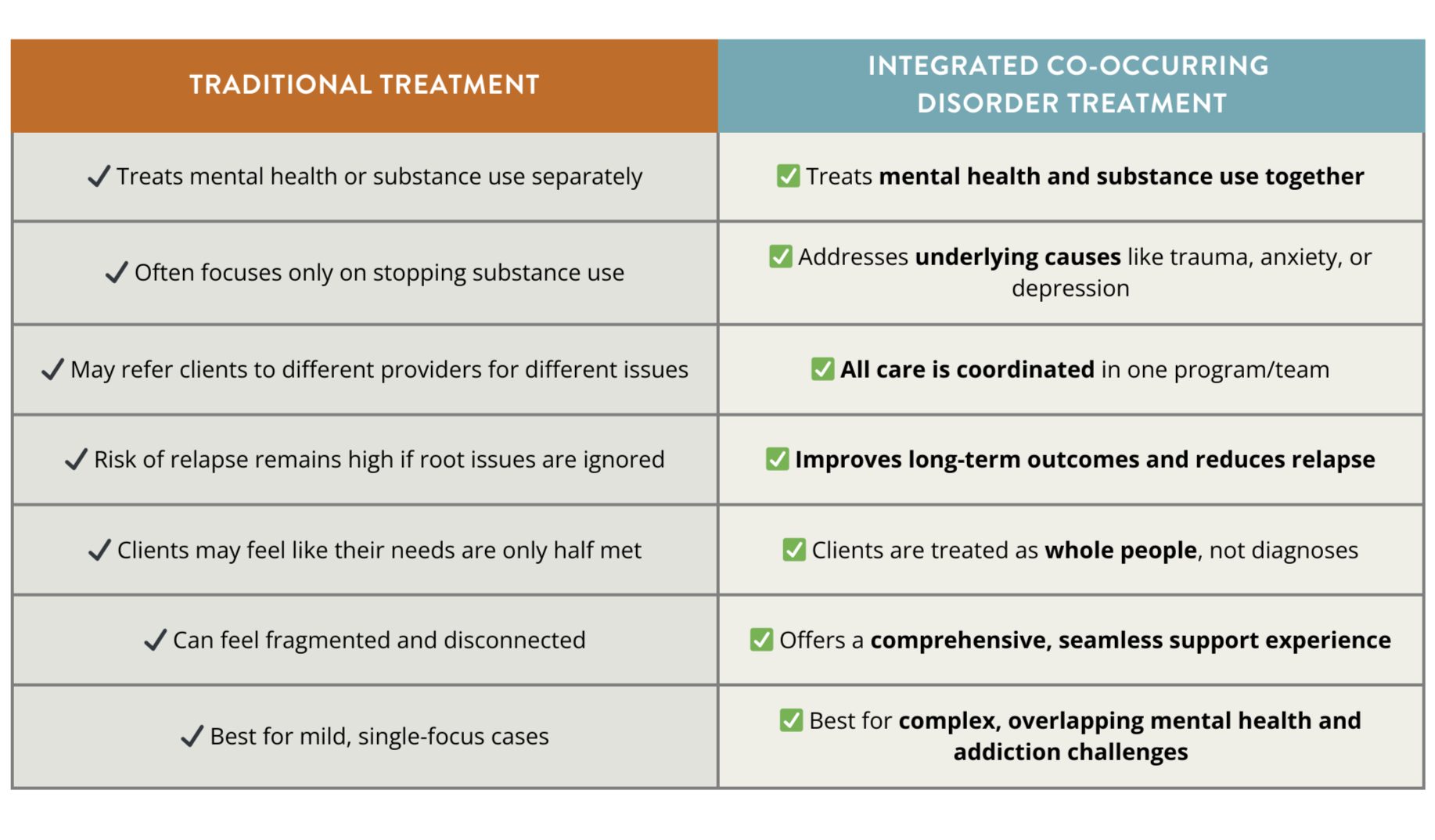
The distinction is about emphasis and coordination—not about labeling one approach as good and the other as bad.
Many addiction treatment programs incorporate mental health support, and many people benefit from specialized services that focus primarily on substance use. Likewise, dual diagnosis treatment in Oregon may be particularly helpful for people whose mental health and substance use concerns are closely connected.
The right treatment depends on the individual. A person's symptoms, substance use, safety needs, support system, age, goals, and previous treatment experiences can all influence what type and level of care is appropriate.
Why Treating Both Can Matter for Long-Term Recovery
Sustainable recovery often involves more than stopping substance use. It can also involve understanding what happens emotionally and physically before, during, and after someone turns to substances.
Integrated care can help someone recognize underlying patterns by exploring questions such as:
What emotions tend to come before substance use?
Are there particular relationships or situations that increase the urge to use?
Does anxiety, depression, trauma, or stress make recovery more difficult?
What happens when difficult feelings can't be avoided?
From there, treatment can help someone develop alternatives. Instead of relying on substances to manage distress, they can learn coping and emotional regulation strategies that support recovery.
Integrated care can also address mental health concerns directly. Anxiety, depression, trauma, and other mental health challenges may require their own attention rather than being treated as secondary to substance use.
Research supports paying attention to both sides of the picture. The Substance Abuse and Mental Health Services Administration (SAMHSA) notes that co-occurring mental health and substance use disorders are common and recommends integrated treatment that addresses both conditions rather than treating them in isolation.
Recovery also involves preparing for setbacks and triggers. Having a difficult day doesn't mean recovery has failed. Long-term recovery can involve having more tools, support, and awareness available when difficult days happen.
What Integrated Treatment Actually Looks Like at INR
A person may come to Insight Northwest Recovery (INR) thinking, "I need help with my anxiety." Another person may think, "My substance use is getting out of control." Someone else may arrive because a parent, partner, or loved one has become concerned.
Treatment creates room to understand the bigger picture.
INR takes a whole-person approach to mental health and substance use, recognizing that people don't necessarily experience these challenges in separate categories. Instead of asking someone to determine which problem is the "real" problem before receiving care, treatment can explore how different experiences may be connected.
Depending on the person's needs and appropriate level of care, treatment may include:
Intensive Outpatient Program (IOP) for a higher level of structured support
Partial Hospitalization Program (PHP)/Day Treatment for more intensive daytime care
Individual and group therapy to address both personal experiences and recovery skills
Family support to help loved ones understand recovery and strengthen communication
Psychiatry and medication management when clinically appropriate
Peer support that can reduce isolation and provide connection with others who understand aspects of the recovery process
INR serves ages 12+, allowing its approach to support teens, college students, young adults, adults, and families in Eugene and Salem.
Whether someone is exploring IOP and PHP Oregon options or simply trying to understand what type of support might make sense, the starting point is understanding the individual—not forcing them into a predetermined treatment path.
One Person, One Treatment Plan
Mental Health + Substance Use + Individual Needs → One Coordinated Treatment Plan → Ongoing Recovery Support
The goal is to make treatment feel connected rather than like a series of separate services.
How Do I Know If Integrated Treatment Might Be Right for Me—or Someone I Love?
You don't necessarily need to determine whether mental health or substance use is the "main problem" before asking for help.
Integrated treatment may be worth exploring when:
Substance use increases during periods of anxiety or depression
Someone repeatedly uses substances to cope with difficult emotions
Mental health symptoms make recovery harder
Previous treatment addressed substance use, but emotional challenges remained
Someone has received separate mental health and substance use services that feel disconnected
Family members aren't sure whether the "main problem" is mental health or substance use
These experiences don't automatically mean someone has a co-occurring disorder. They simply suggest that looking at both sides of the picture may provide useful information.
A professional assessment can help clarify what's happening and what type of support may be appropriate.
You don't have to figure out which concern came first before reaching out.
Recovery Means Caring for the Whole Person
Recovery isn't simply about removing substances from someone's life.
For many people, it's also an opportunity to understand themselves more fully, strengthen relationships, develop healthier ways to cope, and receive support for mental health challenges that may have been there all along.
When mental health and substance use overlap, co-occurring disorder treatment in Oregon can provide a framework for addressing both rather than forcing someone to choose which concern deserves attention.
If mental health and substance use are affecting you or someone you care about, integrated treatment can provide a place to address both.
Contact Insight Northwest Recovery and schedule a free consultation today.
FAQ
-
Integrated treatment for addiction and mental health addresses substance use and mental health concerns within one coordinated treatment approach. Depending on the person's needs, it may combine therapy, substance use treatment, family support, psychiatry, medication management, peer support, coping skills, and relapse-prevention planning.
-
Co-occurring disorders occur when someone experiences a mental health condition alongside a substance use disorder. Mental health symptoms and substance use can influence one another, which is why treatment may be more effective when both concerns are assessed and addressed together.
-
Dual diagnosis treatment is designed to address both substance use and mental health concerns, while some rehab programs primarily focus on substance use and recovery skills. However, treatment programs vary, and many addiction-focused programs also provide mental health services. The most appropriate approach depends on the individual's needs.
-
Anxiety or depression may contribute to substance use for some people, particularly when substances are being used as a way to temporarily manage difficult emotions or symptoms. However, there is no single cause-and-effect relationship. Substance use can also worsen or complicate mental health symptoms, creating a cycle that may be difficult to break without support.
-
Insight Northwest Recovery provides integrated mental health and substance use treatment for people ages 12 and older in Oregon. Services include different levels of care and may include individual and group therapy, family support, psychiatry, medication management, and peer support. Treatment options are available in locations including Eugene and Salem, as well as online services depending on clinical needs.